

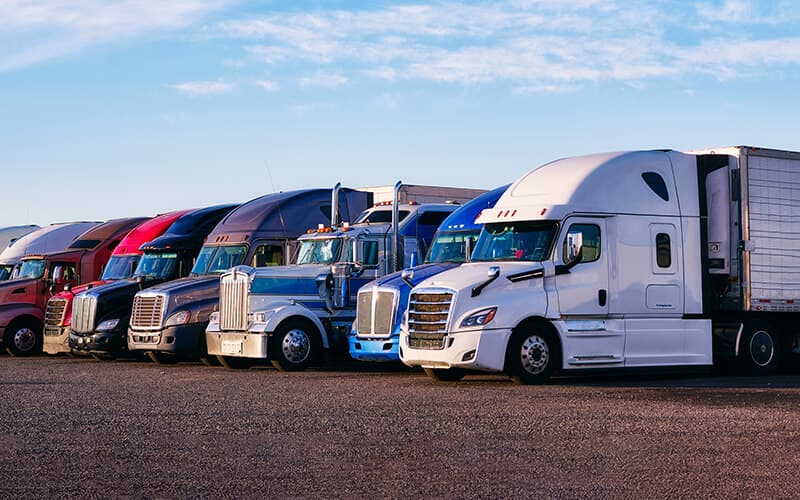
The trucking industry has been describing the truck parking shortage as a supply problem for twenty years. There are not enough spaces, the argument goes, so we need to build more spaces. Congress passed Jason's Law in 2012 to study the shortage. [^1] The FHWA has published reports. The ATRI has published reports. The ATA has lobbied. And yet, as of 2026, the United States is still approximately 140,000 truck parking spaces short of what its commercial vehicle fleet requires on any given night. [^2]
The supply-side framing is not wrong. It is just incomplete. And because it is incomplete, the solutions it generates — federal grants for rest area expansion, public-private partnerships, truck parking apps — address the symptom while leaving the disease untreated.
The disease is zoning.
The Land Is There. The Capital Is There. The Zoning Is Not.
Here is a question that the industry almost never asks: if truck parking is so profitable, and the shortage is so severe, why isn't the private market solving it faster?
The answer is not capital. Private equity has discovered truck parking. Institutional investors are buying portfolios of truck parking lots. The return profile — recurring revenue, low operating costs, real estate appreciation in freight corridors — is attractive. Capital is not the constraint.
The answer is not land. Drive along any major freight corridor in Texas, Louisiana, or the Southeast, and you will see hundreds of acres of undeveloped or underutilized land within a mile of the interstate. The land exists.
The answer is zoning. Specifically, the answer is that most municipalities near freight corridors either prohibit truck parking outright, treat it as a conditional use requiring discretionary approval, or impose restrictions that make commercial-scale truck parking economically unviable. [^3]
ATRI's 2025 survey of state DOTs found that the three most commonly cited barriers to expanding truck parking are: lack of funding (36%), community pushback (27%), and difficulty finding suitable land (22%). [^4] But "difficulty finding suitable land" and "community pushback" are both zoning problems in disguise. The land is suitable. The community does not want it zoned for trucks. The planning commission agrees. The project dies.
What NIMBY Opposition to Truck Parking Actually Looks Like
The pattern is consistent across the country. A developer identifies a parcel near an interchange. The parcel is zoned industrial or agricultural. The developer applies for a conditional use permit or a rezoning to allow commercial truck parking. The application triggers a public hearing. Neighbors show up. They cite noise, traffic, lighting, property values, and environmental concerns. The planning commission, which is elected or appointed by elected officials, denies the permit or imposes conditions that make the project infeasible.
This is not a hypothetical. It is the documented experience of truck parking developers in California, Texas, Florida, and across the Southeast. [^5] The FMCSA's own research acknowledges that community opposition is a primary barrier to new truck parking development. [^6]
The irony is that the same communities that oppose truck parking facilities are served by the trucks that need them. Every Amazon package, every grocery store shelf, every piece of furniture arrives on a truck. The driver of that truck needs somewhere to sleep. The community that benefits from the delivery is also the community that refuses to allow the driver a safe place to park.
The Federal Response Has Been Structurally Inadequate
Congress has appropriated money for truck parking through the Infrastructure Investment and Jobs Act (IIJA) and its predecessors. But federal money for truck parking almost always flows to public rest area expansion — which means it is subject to the same political constraints as any other public works project, and it competes with every other transportation priority for limited right-of-way along federal highways.
Public rest areas are also the wrong model for the scale of the problem. The United States has approximately 1,800 public rest areas. [^7] Even if every one of them doubled its truck parking capacity, the total increase would be insufficient to close the 140,000-space gap — and doubling rest area capacity is not a realistic near-term goal given land constraints along existing highway corridors.
The private market can move faster and at greater scale than the public sector. But the private market cannot build where it is not allowed to build. Federal money spent on rest area expansion while local zoning codes prohibit private development is a policy that is fighting itself.
What an Actual Solution Looks Like
The states and localities that have made meaningful progress on truck parking have done one of three things:
First, they have pre-zoned freight corridors for truck parking. Some states have adopted "freight overlay zones" or "truck-friendly" zoning designations along major corridors that allow commercial truck parking as a by-right use — meaning no discretionary approval, no public hearing, no opportunity for NIMBY opposition to kill the project. By-right zoning is the single most effective tool for accelerating private truck parking development.
Second, they have streamlined the permitting process. Some jurisdictions have created expedited review tracks for truck parking projects, recognizing them as critical infrastructure rather than discretionary commercial development. Pennsylvania recently announced plans to add 1,202 truck parking spaces across 133 locations — a program that succeeded in part because the state treated the project as infrastructure, not real estate. [^8]
Third, they have tied state transportation funding to local zoning reform. A handful of states have begun conditioning transportation grants on local compliance with freight-friendly zoning standards. This is the most politically difficult approach, but it is also the most durable — because it changes the incentive structure for local governments rather than just working around it.
What the Industry Should Be Demanding
The trucking industry spends enormous political capital on hours of service regulations, fuel taxes, and highway funding formulas. It spends almost none on zoning reform — which is arguably the single largest constraint on the private market's ability to solve the parking shortage.
The American Trucking Associations, the Owner-Operator Independent Drivers Association, and the major fleet associations should be advocating for:
- Federal model zoning legislation that states can adopt to pre-zone freight corridors for truck parking as a by-right use
- Conditions on federal transportation funding that require recipient states to demonstrate progress on freight-friendly zoning
- Expedited environmental review for truck parking projects near existing freight infrastructure, recognizing that a paved, fenced lot near an existing interchange has a fundamentally different environmental profile than greenfield development
None of this is radical. Housing advocates have been making similar arguments about residential zoning for a decade, and several states have responded with meaningful reform. The trucking industry has a stronger case: truck parking is not a preference, it is a federal safety requirement. Hours of Service regulations mandate that drivers rest. If there is nowhere safe to rest, the mandate is unenforceable.
The Honest Conclusion
The truck parking shortage will not be solved by apps, by federal rest area grants, or by private equity buying existing lots and raising prices. It will be solved when local governments stop treating truck parking as a nuisance and start treating it as infrastructure — and when the industry stops accepting the zoning status quo as a given.
Until then, every new truck parking app, every new rest area, and every new private lot is a patch on a problem that requires a structural fix. The land is there. The capital is there. The drivers are there. The only thing missing is the political will to let them park.
References
[^1]: Jason's Law (MAP-21, Section 1401). Signed into law July 6, 2012. https://ops.fhwa.dot.gov/freight/infrastructure/truck_parking/index.htm [^2]: Federal Highway Administration. "Truck Parking." https://ops.fhwa.dot.gov/freight/infrastructure/truck_parking/index.htm [^3]: Virginia Transportation Research Council. "Increasing Regional Truck Freight Planning in Virginia." 2025. https://rosap.ntl.bts.gov/view/dot/80405 [^4]: Go Trucking Magazine. "Truck Parking Shortage a National Safety Crisis, ATRI Report Finds." July 10, 2025. https://gotruckingmagazine.com/2025/07/10/truck-parking-shortage-national-safety-crisis/ [^5]: California Freight Mobility Plan. "Economic Impacts of Investment in Public Truck Parking Facilities in California." https://rosap.ntl.bts.gov/view/dot/77398 [^6]: Federal Motor Carrier Safety Administration. "Quantifying the Benefits of Truck Parking." October 2025. https://www.fmcsa.dot.gov/research-and-analysis/quantifying-benefits-truck-parking [^7]: Federal Highway Administration. "Rest Area Program." https://www.fhwa.dot.gov/ [^8]: AASHTO Journal. "State DOTs Investing in Additional Truck Parking." October 10, 2025. https://aashtojournal.transportation.org/state-dots-investing-in-additional-truck-parking/
Share this article
Help other truck drivers discover this content