

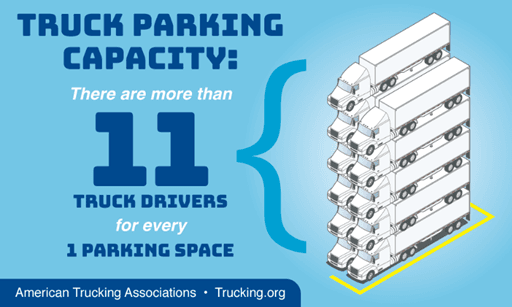
The truck parking industry has a transparency problem. When a driver searches for parking at 9:00 PM on a Tuesday night, they are choosing between listings that all describe themselves with the same vague language: "secure," "well-lit," "convenient." There is no independent standard. There is no score. There is no way to know, before you pull in, whether "secure" means a chain-link fence from 1987 or a monitored gate system with license plate recognition.
This is the problem the BTP Parking Quality Score is designed to solve.
We developed this framework after analyzing thousands of truck parking facilities across the United States, synthesizing driver feedback from our platform, cross-referencing ATRI's amenity and safety feature data, and consulting with fleet safety managers who have to make parking decisions at scale. The result is a 10-point scoring system that any driver, fleet manager, or property owner can apply to any facility.
We are publishing the full methodology here — not as a proprietary secret, but as an industry standard we are proposing. If other platforms, researchers, or regulators want to adopt it, we welcome that.
The 10 Dimensions of the BTP Parking Quality Score
Each dimension is scored on a 0–1 scale, where 0 means the feature is absent and 1 means it is fully implemented. The composite score is the sum of all 10 dimensions, expressed as a number from 0 to 10.
Dimension 1: Perimeter Security (0–1)
A facility scores 1 if it has a fully enclosed perimeter — meaning continuous fencing or barriers with no gaps — and a controlled entry point (gate, boom barrier, or staffed checkpoint). A facility with partial fencing or an open lot scores 0.5. An unfenced lot scores 0.
Why it matters: Perimeter security is the single strongest predictor of cargo theft risk. ATRI's research consistently identifies fencing and controlled access as the top safety priorities cited by truck drivers. [^1] A lot without a perimeter is not a secure lot, regardless of what the listing says.
Dimension 2: Surveillance Coverage (0–1)
A facility scores 1 if it has active camera coverage of the full parking area, including entry/exit points, with footage retained for a minimum of 30 days. Partial coverage scores 0.5. No cameras scores 0.
Why it matters: Camera coverage deters theft and provides evidence when incidents occur. Fleet managers increasingly require documented camera coverage as a condition of approving a facility for driver use. Without it, cargo claims are nearly impossible to substantiate.
Dimension 3: Lighting Quality (0–1)
A facility scores 1 if it has full-lot LED or equivalent lighting that eliminates dark zones throughout the parking area. Partial lighting scores 0.5. Minimal or no lighting scores 0.
Why it matters: Inadequate lighting is the leading environmental factor in driver assault and cargo theft at truck parking facilities. ATRI identifies lighting as one of the top five safety features drivers prioritize. [^2] It is also one of the cheapest to fix — making its absence at a paid facility particularly inexcusable.
Dimension 4: Surface Condition (0–1)
A facility scores 1 if it has paved, level, well-maintained surfaces with no significant potholes, drainage issues, or surface damage. Gravel or compacted surfaces score 0.5 if well-maintained. Unpaved, rutted, or poorly drained surfaces score 0.
Why it matters: Surface condition affects driver safety during entry and exit, vehicle damage risk, and the ability to operate in wet or winter conditions. A lot that becomes impassable in rain is not a reliable facility.
Dimension 5: Space Dimensions (0–1)
A facility scores 1 if it has standard 12-foot-wide by 75-foot-deep pull-through or back-in spaces that accommodate a standard 53-foot trailer with a day cab or sleeper. Spaces that require difficult maneuvering or are undersized for standard configurations score 0.5. Spaces that cannot accommodate standard configurations score 0.
Why it matters: Undersized spaces cause accidents, damage, and driver frustration. A facility that advertises truck parking but cannot accommodate a standard rig is not a truck parking facility.
Dimension 6: Restroom Access (0–1)
A facility scores 1 if it has clean, 24-hour-accessible restrooms on-site. Restrooms with limited hours score 0.5. No restrooms score 0.
Why it matters: Hours of Service regulations require drivers to rest for 10 consecutive hours. A facility without restroom access is not a viable rest location for a 10-hour break. This is not a comfort amenity — it is a basic operational requirement.
Dimension 7: Real-Time Availability (0–1)
A facility scores 1 if it provides real-time space availability through a digital platform, app, or live signage at the entrance. Availability information that is updated daily or less frequently scores 0.5. No availability information scores 0.
Why it matters: A driver who cannot know whether a facility has space before driving to it cannot plan their HOS break reliably. Real-time availability is the difference between a reservation system and a gamble. Facilities that do not provide this information are forcing drivers to make compliance decisions blind.
Dimension 8: Reservation Capability (0–1)
A facility scores 1 if drivers can reserve a space in advance through a digital platform. Same-day reservation only scores 0.5. No reservation capability scores 0.
Why it matters: The Hours of Service clock does not stop while a driver circles a full lot. Advance reservation is not a luxury — it is a safety feature. Facilities that do not offer it are contributing to the conditions that lead to HOS violations and fatigued driving.
Dimension 9: On-Site Services (0–1)
A facility scores 1 if it offers at least three of the following: fuel, food/restaurant, shower, laundry, truck wash, maintenance services, or a driver lounge. One or two services score 0.5. No services score 0.
Why it matters: Drivers who can accomplish multiple tasks at a single stop are more efficient and less fatigued. Facilities with services command higher utilization and justify premium pricing. This dimension rewards the facilities that invest in the full driver experience.
Dimension 10: Management Responsiveness (0–1)
A facility scores 1 if it has a documented process for handling incidents, complaints, and maintenance requests with a response time of under 4 hours during operating hours, verified by driver reviews. Average or inconsistent responsiveness scores 0.5. No documented process or consistently poor reviews score 0.
Why it matters: A facility's physical attributes matter less than how it responds when something goes wrong. A theft, a maintenance failure, or a billing dispute handled poorly destroys trust permanently. This dimension captures the operational quality that physical inspections cannot.
How to Read the Score
| BTP Score | Rating | What It Means | |-----------|--------|---------------| | 9.0–10.0 | Platinum | Best-in-class facility. Meets or exceeds every standard. Appropriate for high-value cargo and fleet-approved use. | | 7.0–8.9 | Gold | Strong facility with minor gaps. Reliable for most use cases. | | 5.0–6.9 | Silver | Adequate but with meaningful deficiencies. Suitable for short stops; review specific gaps before extended stays. | | 3.0–4.9 | Bronze | Below standard. Use only when no better option is available. | | 0–2.9 | Unrated | Does not meet minimum standards for safe truck parking. Not recommended. |
Why We Are Publishing This
The truck parking industry is fragmented, opaque, and underinvested. Drivers make safety-critical decisions with almost no reliable information. Fleet managers approve facilities based on word of mouth and outdated inspections. Property owners have no standard to aspire to.
The BTP Parking Quality Score is our attempt to change that. Every facility listed on BestTruckParking.com is evaluated against these 10 dimensions. Scores are displayed publicly. Operators who improve their facilities can request a re-evaluation. Drivers who identify discrepancies can report them.
We are also inviting the industry to adopt this framework. If you are a fleet safety manager, a DOT researcher, an insurance underwriter, or a property developer, we would welcome a conversation about how to make this a genuine industry standard — not a proprietary metric owned by one platform.
The truck parking shortage will not be solved by building more bad lots. It will be solved by building better ones, and by giving drivers the information they need to find them.
References
[^1]: American Transportation Research Institute. "State-Level Public Truck Parking Findings." April 2025. https://truckingresearch.org/2025/04/truck-parking-index/ [^2]: ATRI. "Truck Parking Shortage a National Safety Crisis." July 2025. https://gotruckingmagazine.com/2025/07/10/truck-parking-shortage-national-safety-crisis/
Share this article
Help other truck drivers discover this content